3 Nov 2025
The forthcoming LST-1 Cycle 4 observation program will start on April 3th 2026 and continue through April 18th 2027 (13 observation periods). For this Cycle 4, a joint LST+MAGIC call for proposals scheme has been organised, aiming to maximise the science exploitation that the two instruments bring together. For this call, LST-1 observation time will available on a best-effort basis. Following submission, the proposals will be evaluated by the Time Allocation Committee (TAC), which is composed by members of the MAGIC and LST collaborations.
The call for LST-1 observation proposals is not open for external scientists. Note however that both LST-only and joint MAGIC-LST observations are open to external co-investigators (co-I), provided they agree to a Non-Disclosure Agreement with the LST collaboration.
3 May 2024
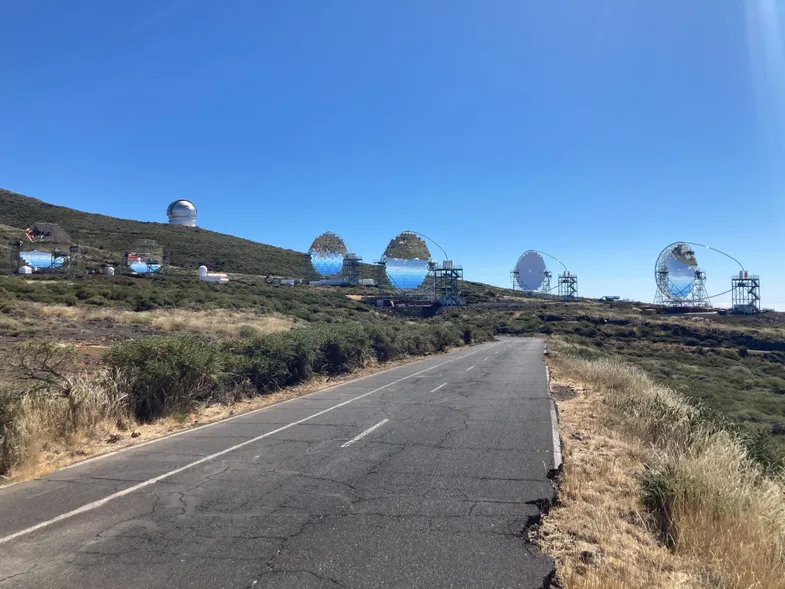
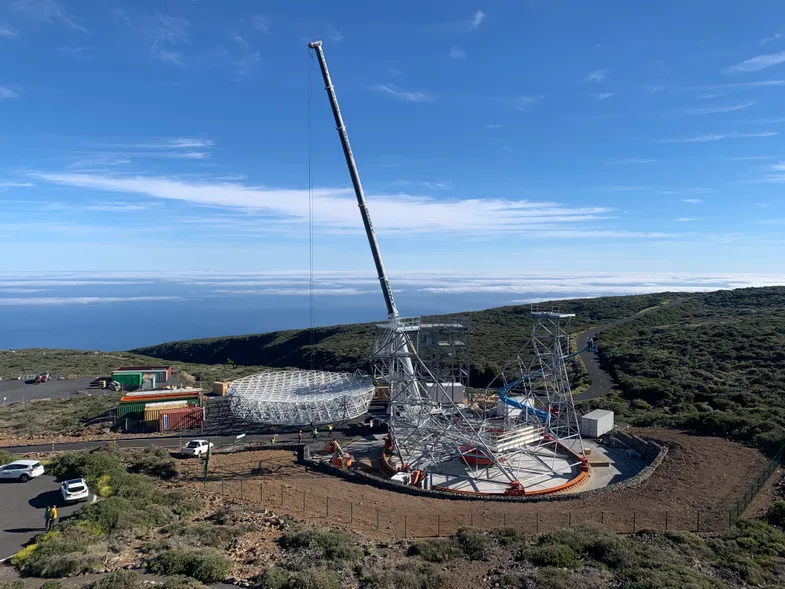
Until recently, the prototype of the Large-Sized Telescope (LST), the LST-1, has stood alone on the CTAO's northern hemisphere array site at the Instituto de Astrofísica de Canarias' (IAC's) Roque de los Muchachos Observatory in Villa de Garafía on La Palma, Spain. But, in 2023, the CTAO LST Collaboration began laying the foundations and constructing the three remaining LSTs planned for the site -- the LST-2, LST-3 and LST-4. It was on 3 May that an important milestone was achieved when the 18-tonne mirror dish structure of the LST-4 was successfully lifted onto its lower structure.
26 Dec 2023
La Palma, Spain - On 15 December, the Large-Sized Telescope (LST) Collaboration announced through an Astronomer’s Telegram (ATel) the detection of the source OP 313 at very high energies with the LST-1. Although OP 313 was known at lower energies, it had never been detected above 100 GeV, making this the LST-1’s first scientific discovery. With these results, OP 313 becomes the most distant Active Galactic Nuclei (AGN) ever detected by a Cherenkov telescope, further showcasing the LST prototype’s exceptional performance while it is being commissioned on the CTAO-North site on the island of La Palma, Spain.
OP 313 is what is known as a Flat Spectrum Radio Quasar or FSRQ, a type of AGN. These are very ...
22 Jun 2020
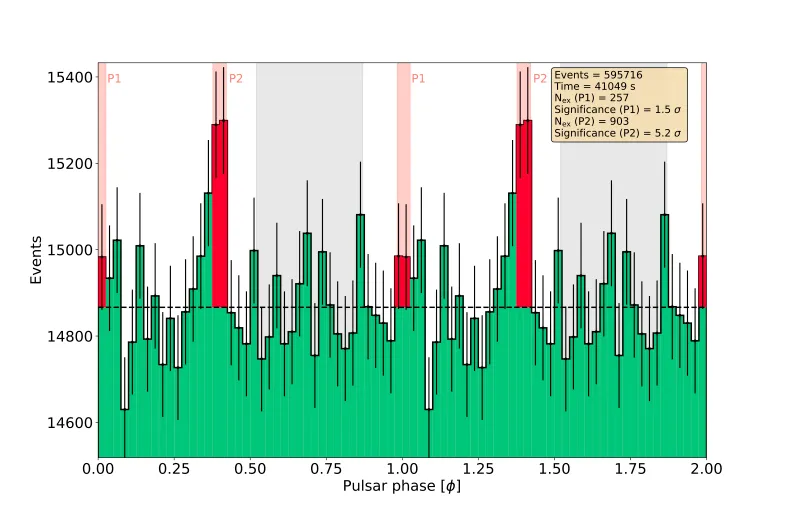
Between January and February 2020, the prototype Large-Sized Telescope (LST), the LST-1, observed the Crab Pulsar, the rapidly rotating neutron star at the centre of the Crab Nebula. The telescope, which is being commissioned on the CTA-North site on the island of La Palma in the Canary Islands, was conducting engineering runs to verify the telescope performance.